A board meeting is where you find out
whether your records are real.
Where this started
Golden Bay Towers is an 89-unit cooperative on the Intracoastal Waterway in Hallandale
Beach. Twin six-story towers, opened in 1962, architect Harold Wiecer, private boat
docks, and a framed original sales brochure still hanging in the lobby. Like 30 to 40
percent of community associations in the United States, it is self-managed — no
management company, a volunteer board, and a president who signs things. That
president is the person who went on to build this software.
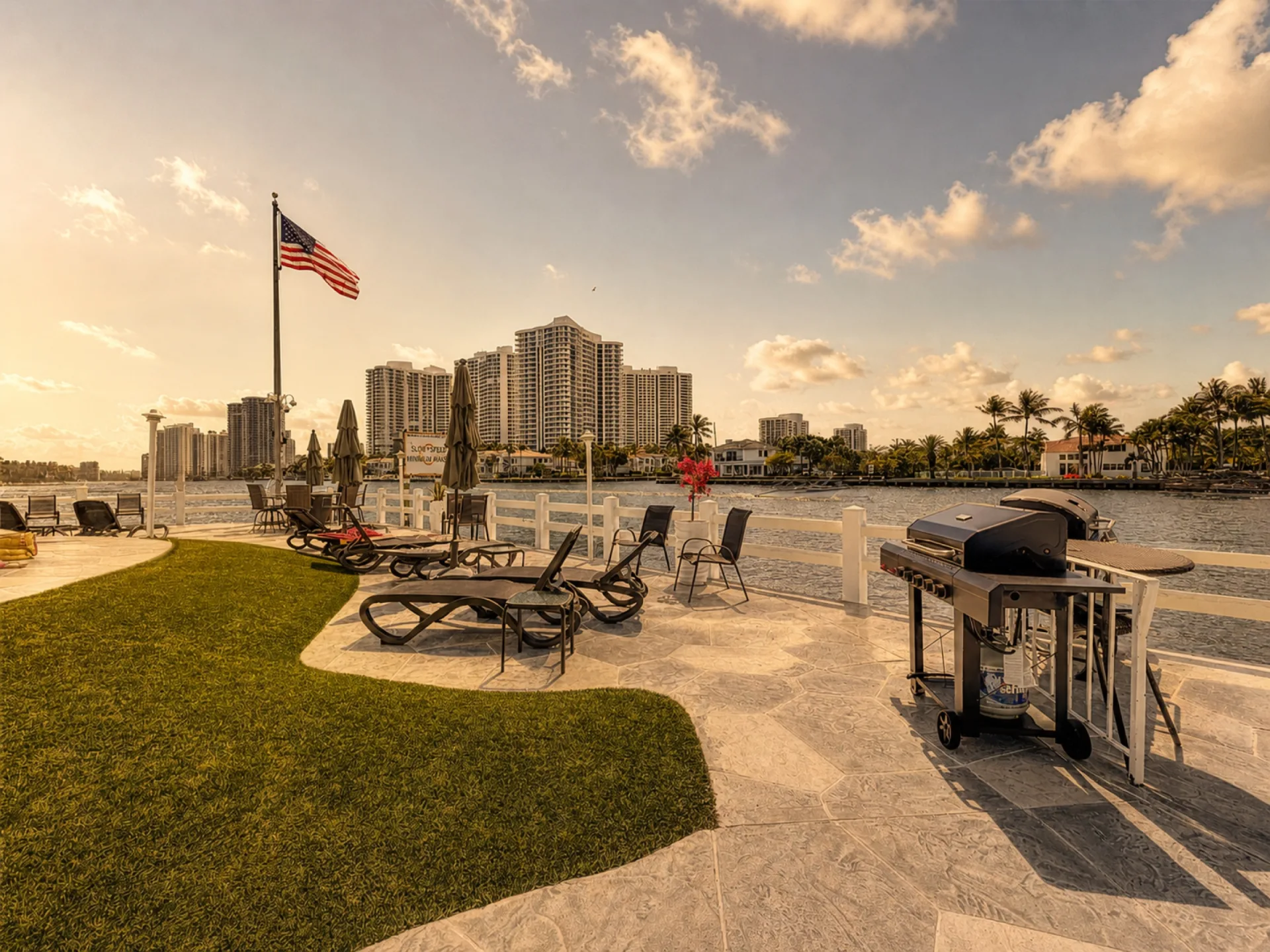
Golden Bay Towers, Hallandale Beach. The sun deck and the boat docks were both
promised in the 1962 sales brochure.
Self-management, in practice, meant a filing cabinet, a shared inbox, and a spreadsheet
that only one person understood. The bylaws were a PDF someone emailed around. The
answer to “can my daughter park in the visitor space over the holidays”
depended on who you asked and how recently they had read the house rules. Nobody was
doing anything wrong. There was simply no record that could be relied on twice.
So the first thing we built was not software. It was a book: The Florida Co-Op
Board Handbook — 29 chapters and 203 companion forms setting out what
Chapter 719 actually requires of a cooperative board, week by week, published by LRI
Press. Writing it forced the question that software eventually had to answer: if this
is what a board is supposed to do, what would it take to actually do it on a Tuesday?
LRI Connect is the answer we built for ourselves and then finished properly. The
general ledger, the minute book, the compliance calendar, the document library, and
the resident’s question at eleven at night all run on one association record.
Golden Bay Towers has run on it since before it had a price.
See what that looks like.
LRI Connect is published by
Luxury Realty International,
a South Florida firm offering brokerage, property management, and concierge services.
Public property websites — including
goldenbaytowers.com
— are a separate design engagement through LRI Studio.
LRI Press
We wrote the book first
Most software companies write a white paper. We wrote 768 pages, footnoted them to the
statute, and sold them to boards who had no interest in buying software. The handbook
has to stand up on its own, in front of readers who will check it against Chapter 719.
That is the fastest way to find out how we think before you ever speak to us. Read a
chapter. If the book is wrong about your building, the platform will be too.
Twenty-nine chapters on governance, meetings, records, budgets, elections, the physical
plant, and compliance. Chapter 719 is not Chapter 718, and a co-op board handed a condo
manual is being quietly misinformed about elections, records, and share transfers.
One person signs the minutes and the release notes
Anthony Clemenza
Founder
President of Golden Bay Towers, the 89-unit Hallandale Beach cooperative described
above — an office he holds today and has held for years. Author of The Florida
Co-Op Board Handbook and founder of Luxury Realty International, LRI Press, and LRI
Connect. He reads the meeting packet and the pull
request in the same week, which is the whole argument for this company and also its
main scheduling problem.
IMPORTANT LEGAL NOTICE
Anthony Clemenza is admitted to practice law in New York only and is not admitted to practice law in Florida. Mr. Clemenza provides this material as general educational information, drawing on publicly available law and his experience serving as president of a Florida cooperative association; he is not acting as legal counsel in connection with this material. This material is not legal advice, does not address any person's or association's particular circumstances, and does not create an attorney-client relationship. LRI Connect and Luxury Realty International are software and web-services businesses, not law firms, and do not offer or provide legal services. Florida law changes, and a lawyer licensed in Florida should be consulted before anyone acts or relies on this material.
Commitments
Four things we will not do
01
Answer from a document nobody approved
Uploading a document does not make it answerable. A file sits in the library until
someone with authority marks it approved for the concierge and sets who may see it.
When the approved record does not cover a question, the honest reply is that it does
not, and it goes to a person.
02
Quote a competitor’s price we cannot source
BuildingLink publishes no pricing anywhere. Every figure in circulation is second-hand,
and one of them traces back to an article from 2009. So we compare on scope, which we
can show you, and leave the arithmetic to whoever will actually quote you.
03
Give you legal advice
We will tell you what the statute says and when it is due. Whether your board should
do the thing, and whether it did it correctly, is a question for a Florida attorney.
The platform is built to hand that lawyer a record they can read, not to replace them.
04
Price by the unit
Per-unit pricing turns every conversation into a comparison with the cheapest portal on
the market, and it punishes the small buildings that need the record most. A launch
fee and a flat monthly band for your size. The number does not move because you added
a unit.